HOW TO PLAY VIDEO
THE RULES PDF
THE TAROT RESTLESS EXPANSION RULES PDF
FAQs and Known Issues
The rules state that there are 28 cards in the Status Effects deck, but there are actually 24.
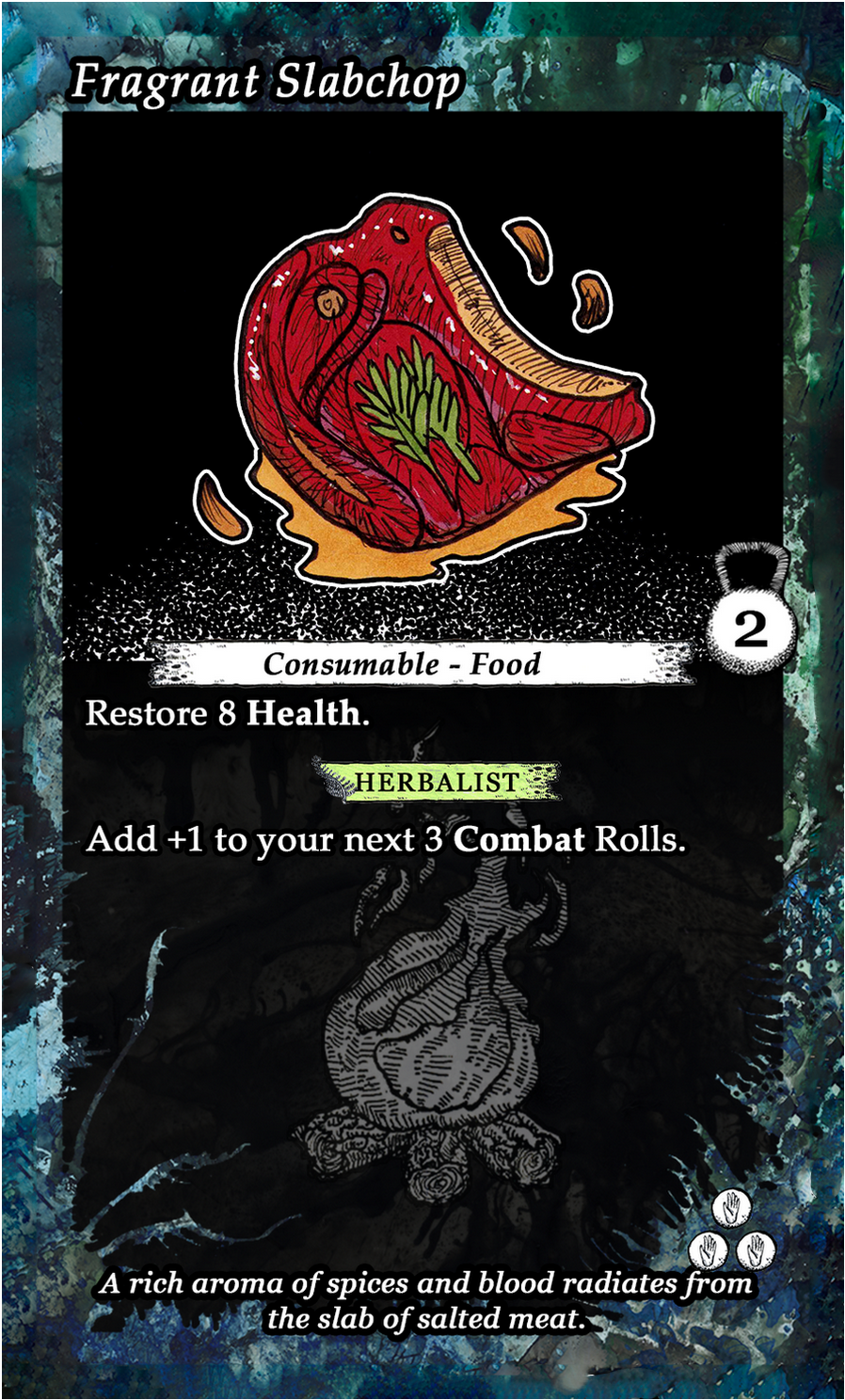
In the rule book, on the top right corner of page 9, I write that the example item Fragrant Slabchop has 8 Armor. It doesn’t - it restores 8 Health.
The Realm 5 card, Hours of Gasping Death, should have the text that informs the players to reveal the Traitor God at the start of the Realm.
The Hack’s Shortbow loot weapon should have a DEXTEROUS trait tag before “Add an Additional +1 to both Ranged and Dodge rolls,” meaning that bonus is only given to those with the DEXTEROUS trait.
What’s in the Box?
Note: Thanks to the success of the Kickstarter, this game has been enhanced with 10 extra Sin cards and the Hierophanies of The Abyss blank card expansion. Remove unused blank cards before playing. If you add a custom Rest card to the game, I encourage you to remove a non-Restless Horror card from the same deck. If you add your own Treasures to the game, remove a non-Sin Treasure card to maintain the probability of finding a Sin.
205 Encounters
24 Status Effects and Reminders
263 Loots
23 Characters
35 Rests
14 Traitor Gods
60 Realms
26 Starter Items
212 Treasures
200 Counters
Also included:
D4 + D20 + Cloth Bag + Rule Book + Tarot Rule Book
The Game
A team of 1-4 players choose characters and starting equipment before exploring five realms of increasing difficulty. As they travel, they fight beasts, divine and profane creatures, and fellow humans, trade with merchants, and gather the tools needed to fight and kill one of the traitor gods that condemned humanity to extinction. Behind them, a storm of ink-black smoke slowly sweeps across the world, swallowing and obscuring all. As they fight, they lose health. While there are many methods of restoring health, the most reliable source of healing occurs while resting. The smoke draws nearer with every passing moment, and the party only has 3 nights of rest available before they must press forward or die.
Do not let these rules intimidate you. I designed this game so that both new and experienced players could enjoy it together. After the first few hands, everything will make sense.
No rule book can cover every possible situation of a game. If you are confused, try for a reasonable solution that maintains the oppressive mood and challenge of the game. If you have a specific question, check out the Ask Me A Question section at the bottom of the page.
Setting up the game
As a party:
- Draw 6 Character cards. Of them, choose 4 to create your party, with each player controlling 1 Character. If there are fewer than 4 players, a player may control more than 1 Character. Return the unused Character cards to the deck.
- Give each Character a supply of Counters equal to their Health points. Use these to track your Health. Tip: Don’t discard them when losing Health, just put them aside so you can keep track of your total Max Health.
- Draw 6 Starter Item cards and pick which 4 should be kept. These can be given to any Character and Characters can have more than 1 Starter Item.
- Draw 3 Rest cards and place them face-down on the table.
- Gain 5 shared Reroll Counters. Any Character can use these to reroll any roll.
- Draw a Realm 1 card and read it aloud.
- Place 4 Encounter cards face-down in a row in the middle of the table. The first Encounter of the game is a Pick From 3, so add 2 Encounters on top of it.
- The game begins when the party reveals the 3 possible Encounters to choose as their first. Pick the preferred Encounter and begin. When that Encounter is finished, move on to the next. When all Encounters are finished, move on to the Realm 2.
THE TABLE
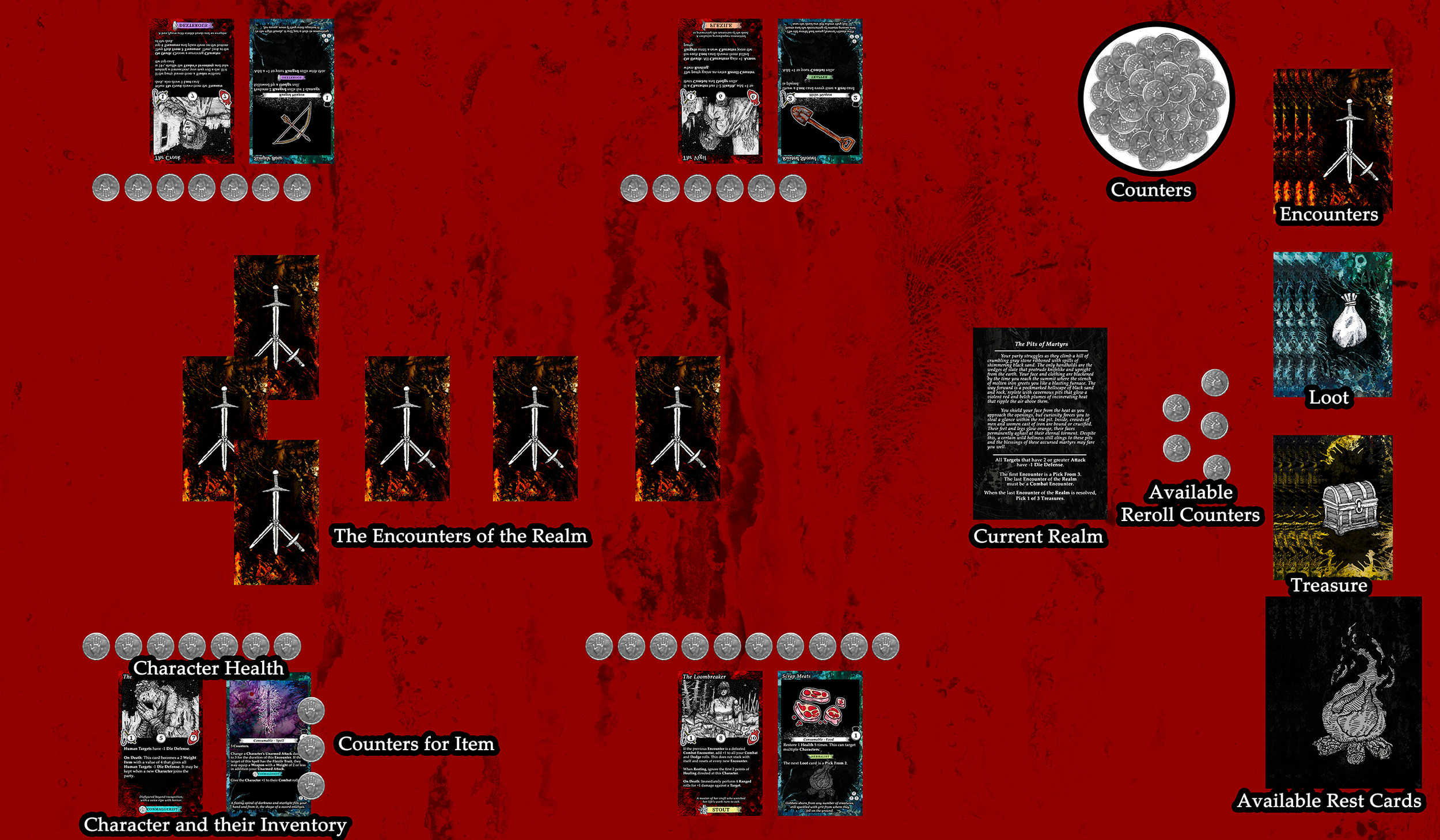
Not Pictured: The discard piles, which should be kept near their respective decks.
Notes: The first encounter of the game is Pick From 3. Leave room for your Inventory next to your Character. Keep the Encounter, Loot, and Treasure decks, as well as the currently available supply of Reroll Counters, the bag of Counters, and the 3 Rest cards available to the party close at hand. If possible, keep the Realms nearby.
HOW TO TRACK HEALTH AND ARMOR
The game comes with 200 counters that can be used to track any quantifiable information in the game. First and foremost, Health. Create a Health Bar by putting Counters equal to your Health above your Character. As you take damage, don’t discard the counters, simply move them to the right so that the counters on the left represent the remaining Health, the counters on the right represent the missing Health from the total, and all counters represent your current Max Health. When a Character receives a boost to their Max Health, simply add the counters(s) to the right side of the line, as Max Health only increases the available maximum and does not provide healing. You can also use Counters to track the health of Targets or Traitor Gods.
If a Character gains Armor that is added directly to their Character, place counters equal to their armor above their Health bar. Armor on items goes on the side of the card that provides it. As Armor is used, discard these counters.
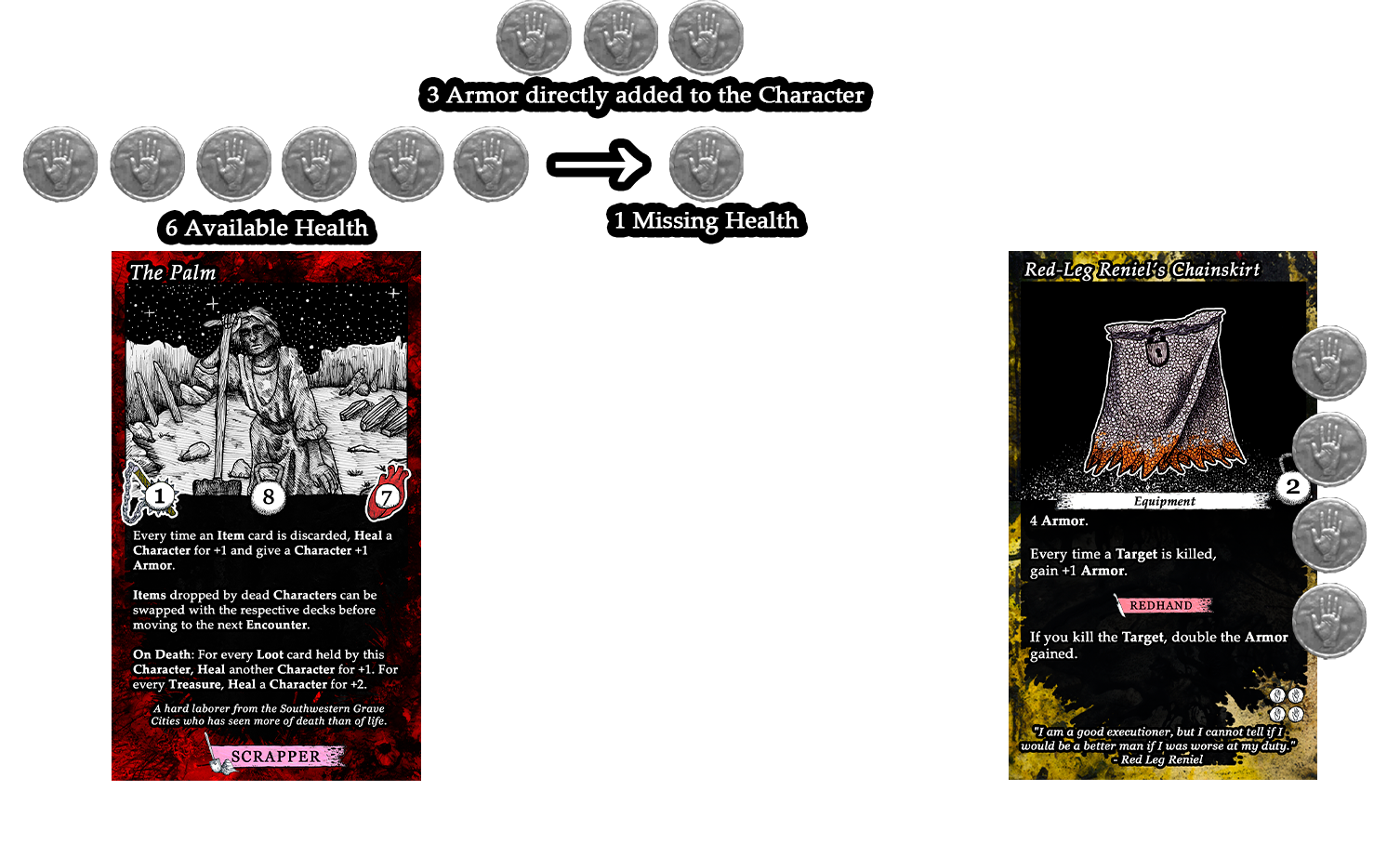
The above Character has 6 of 7 Health available, with 3 Armor on their Character card and 4 armor on their Treasure item. When taking damage, Characters must use Armor but may choose which source from which to draw.
CHARACTER
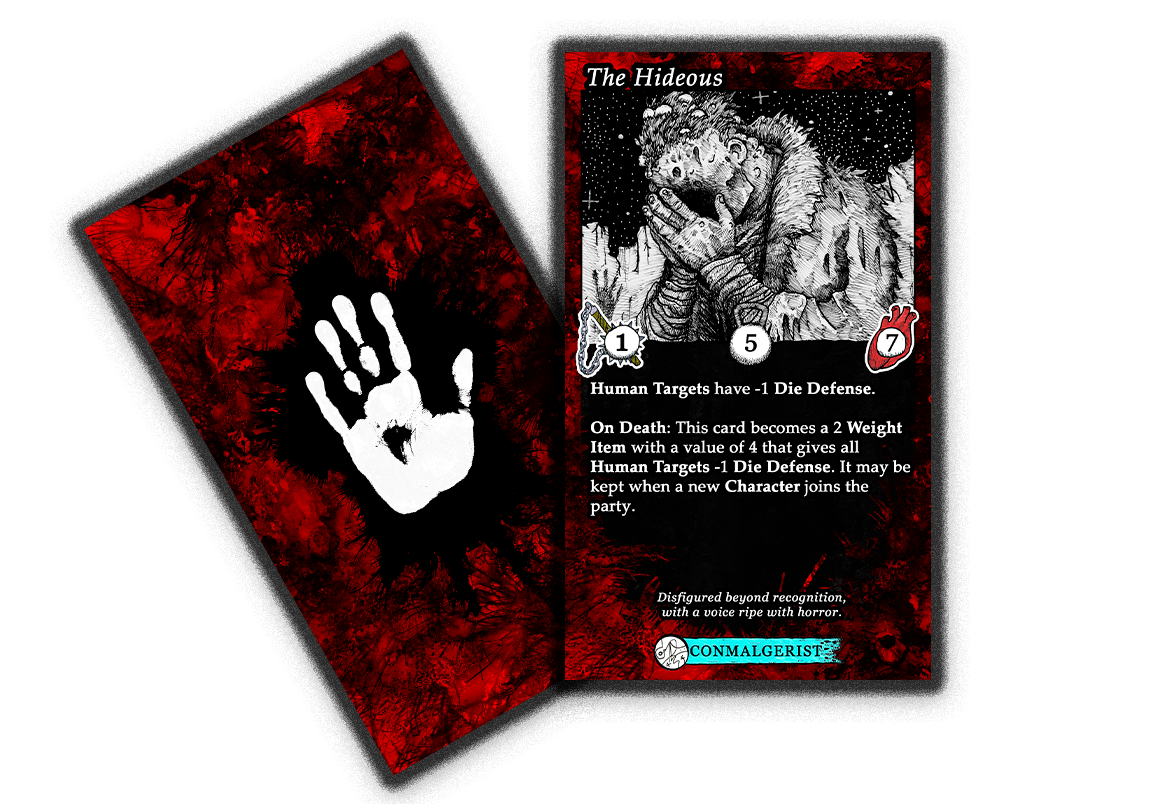
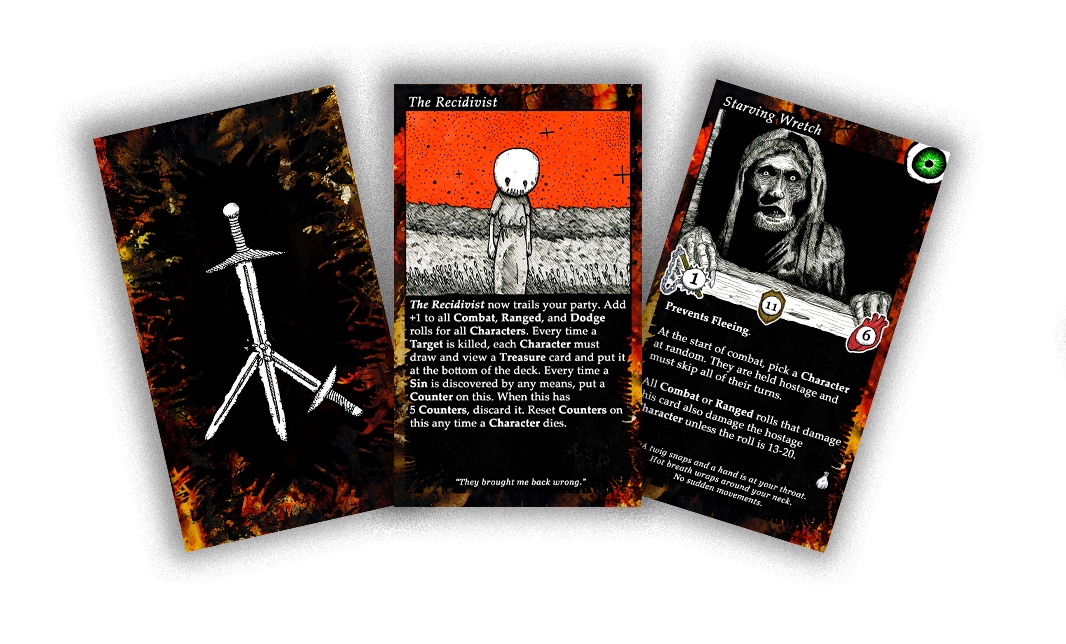
Each player controls a Character. Across the middle of the card, Characters have Unarmed Attack Power, Inventory Size / Max Weight, Health. Below that, Special Text, a Death Effect, and a Trait. Items have Weight and Characters can only carry as much as their Max Weight.
Any Character can use any item in the game, but cards with Trait Tags that match the Character’s trait offer extra uses. Cards with global effects like Encounters, Realms, or Traitor Gods only need the Trait on a Character in the party to be activated. These effects do not stack, e.g. having two Herbalists does not trigger a card with an Herbalist tag twice.
STATUS EFFECTS
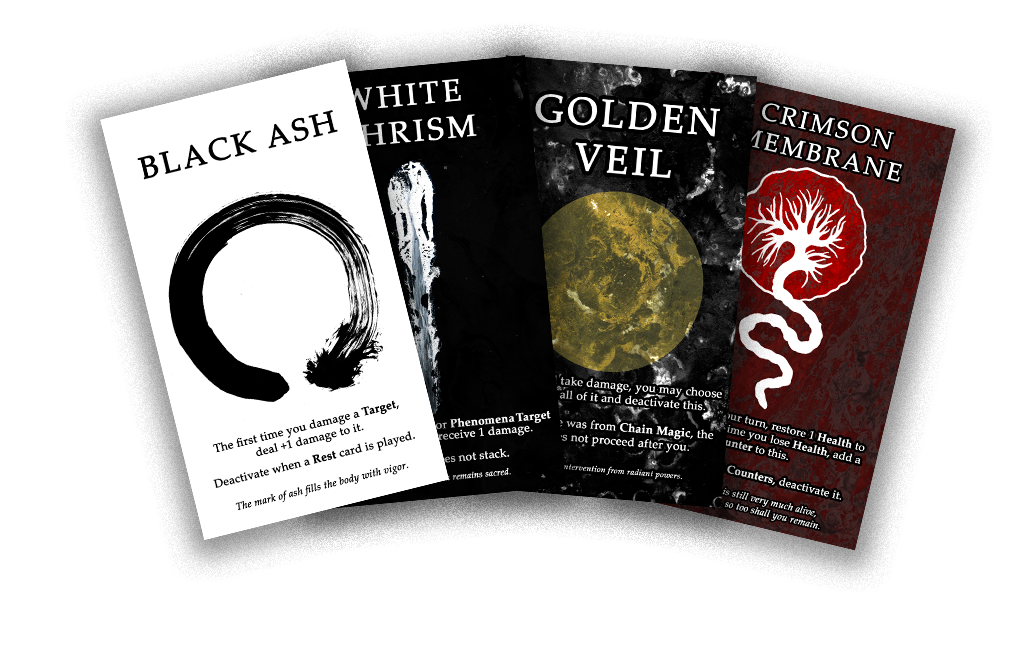
There are 4 types of beneficial conditions that affect individual Characters. A Character may have multiple Status Effects but may not stack a single effect type unless otherwise noted. They weigh nothing and cannot be transferred, traded, or dropped. They are retained if a Character is transfigured, but disappear upon death.
Note: This game includes the Hierophanies of the Abyss expansion, which includes 4 Blank Status Effect cards. Do with them what you will.
ENCOUNTERS
Non-Combat Encounters: Unique opportunities, challenges, misfortunes, and Traders.
Note on Traders: Traders are optional. To access a Trader’s Inventory, the party pays 1 Reroll Counter. The Inventory is normally 2 Loot and 2 Treasure cards, drawn and revealed by a Character the party selects. Traders buy and sell at the Value shown on the bottom right corner of Item cards. Reroll Counters may be used as currency, with each being worth 1 Value, either to cover shortfalls or as payment from selling Items. Items may be sold to the Trader without paying to view the Inventory. Overpayment is refunded in Reroll Counters. When leaving, discard the Trader’s Inventory. This action does not trigger any Discard effects. Trader Inventories are distinct from normal card draws, so effects like “Pick From 2” do not apply unless stated. Some cards may expand the Trader’s Inventory.
Combat Encounters: Encounters that must be resolved through fighting or fleeing. Read the Combat section for more information.
Note on adding Combat Encounters: When instructed to Add a Combat Encounter or if an Encounter Must Be a Combat Encounter, reveal it as normal. If it is anything other than a Combat Encounter, replace it until a Combat Encounter is drawn and then shuffle the unused Encounters back into the deck.
Items:
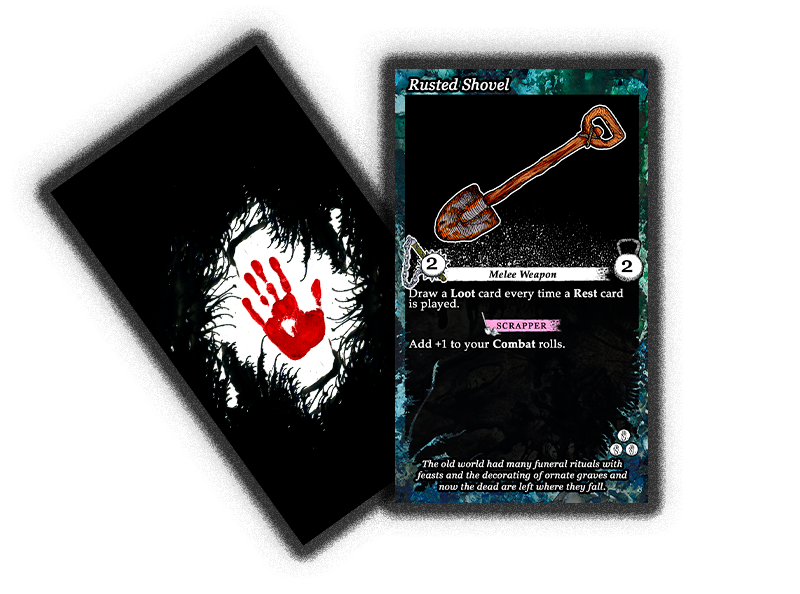
Items include Active Items, Equipment, Consumables, Weapons, and all their subgroups. To gain an item, it must be put in a Character's Inventory. If there is no room, other items can be discarded. When the party moves from one Encounter to another, all Items not held in a Character’s Inventory are discarded.
This is a cooperative game, so all Items held in Character Inventories are revealed to all other players at all times. Characters can trade Items amongst themselves any time that is not Battle.
Pay attention to who draws cards. If the text says that a card can be drawn, it is up to the party to determine who will draw it. If the text says a certain Character (i.e. you) must draw the card, you must be the one to draw it.
STARTER ITEMS
Starter Items are basic Items that Characters acquire at the start of the game.
Loot
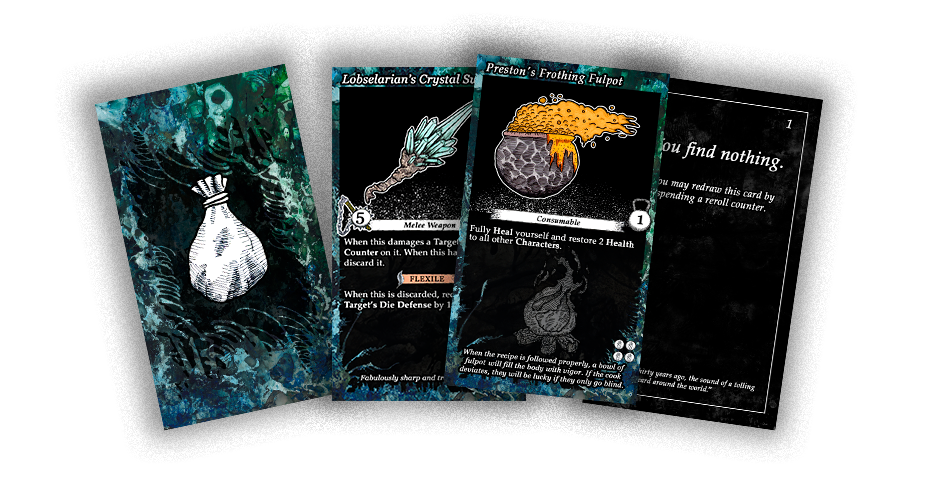
Loot contains Weapons, Consumables, and Equipment, as well as 33 Nothing cards, which must be discarded or rerolled .
Treasure
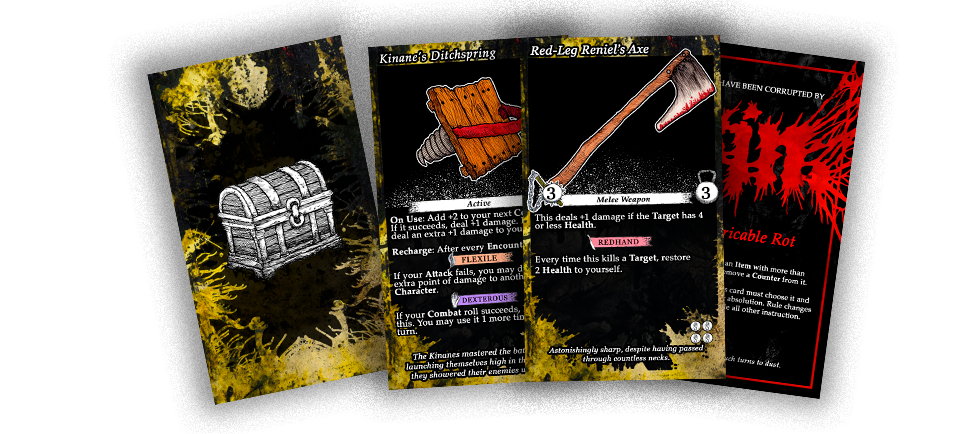
Treasure contains powerful Weapons, Consumables, Equipment, and Sin cards.
Note: Sin cards bind to the Character that reveals them. If one or more appear in a Pick From Multiple Treasures event, they MUST be taken by whoever reveals them and no Treasure will be acquired by the party. If they appear in a Trader Inventory, Sins must be taken, and the slot is refilled with another Treasure. If instructed to view or reveal Treasures and then discard or place them at the bottom of the deck, Sins remain on the Character that revealed them. Sins are discarded only when Absolved or when the Character that revealed them dies.
Types of Items
Consumable: Items with limited uses that must be discarded upon use or when no Counters remain. Some Consumables have X Counters on them, meaning they can be used multiple times before discarding. If a Consumable does not have Counters listed, it is considered to have 1 Counter. Within this category are Food items, which can offer healing during Rest, and Spells, which can have a variety of uses.
Active: These have unlimited uses but must be recharged between each use. If an Active Item has a recharge period based in Encounters, this is inclusive of the Encounter in which it was used. If an Active Item recharges every 2 Encounters, that means when it is used in an Encounter and made inactive, it remains inactive for the duration of the next Encounter, and then becomes available again at the start of the Encounter that follows.
Weapon: This category includes Melee Weapons and Ranged Weapons. Melee Weapons replace a Character’s Unarmed Attack damage with the damage indicated on the card. Ranged Weapons used Ranged rolls and tend to have multiple chances to hit a Target. More on Combat and Ranged rolls in the Combat section.
Equipment: Confers passive benefits to a Character or the entire party.
Fragrant Slabchop (left) - This is a Consumable - Food Item that weighs 2 and has can be used once. 8 Armor. If a Herbalist is carrying it, they gain access to the Herbalist Trait bonus.
In the bottom right corner, the Item Value is listed as 3.
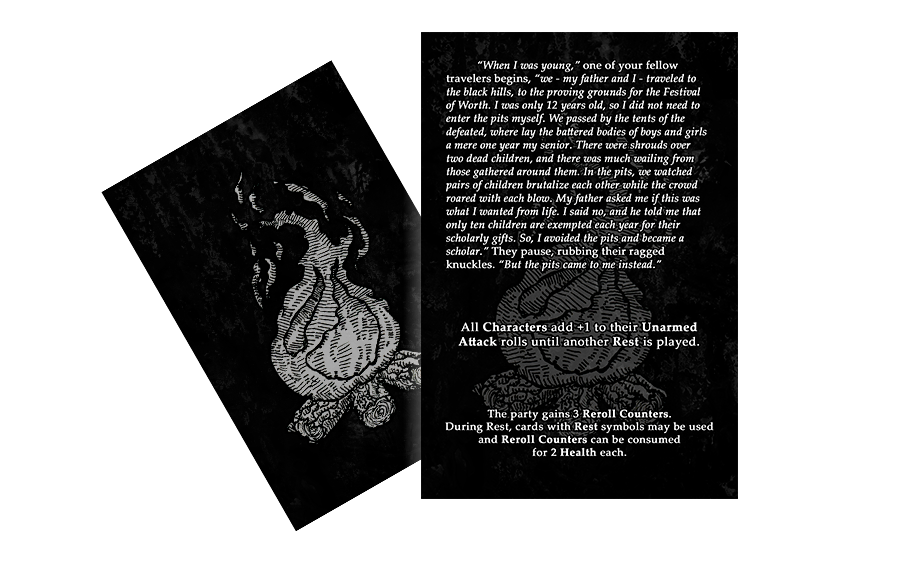
Note: If an Item has the Rest symbol in the background of the Special Text, it can ONLY be used when at Rest.
REST CARDS
Rest cards offer a chance at healing. The party receives 3 at the start of the game. Keep them face-down. They may be played after defeating a Target or at a Non-Combat Encounter. When Resting, all players with dead Characters rejoin the party with a new Character. The party also gains 3 Reroll Counters and, while Resting, Characters may spend Reroll Counters to restore 2 Health to any Character.
While Resting, players can:
- Use unlimited Consumable Items.
- Use Items marked with the Rest symbol.
- Use charged Active items that do not require a Target.
- Trade all Items freely.
When Resting, any Item that does not fit into a Character inventory is considered On the Ground and can be used by anyone.
REALMS
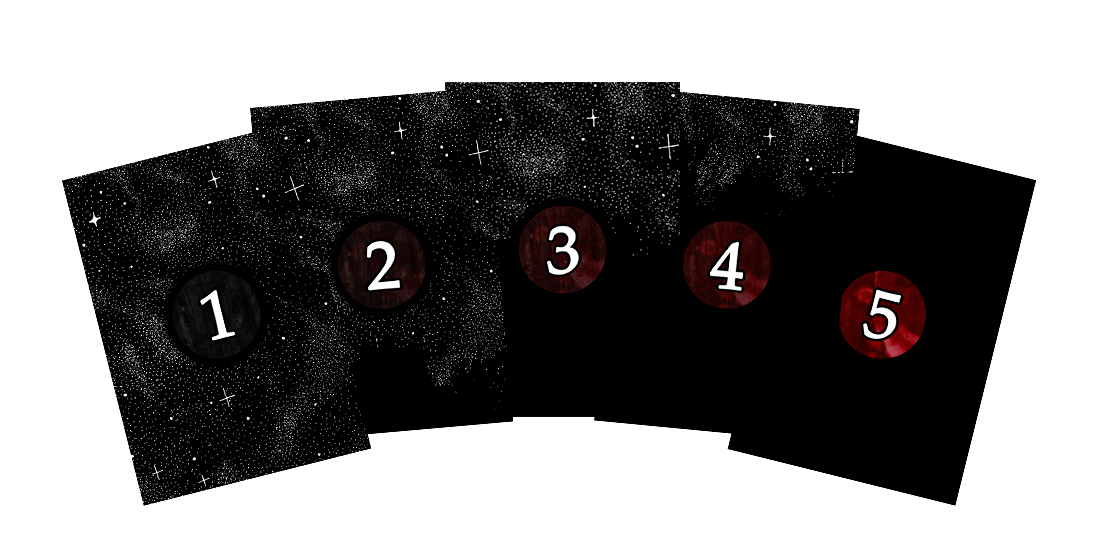
The game consists of 5 Realms of increasing difficulty. Realm cards apply global changes to the rules for the Encounter cards below them. The first Realm is drawn from the Realm 1 deck, the second from the Realm 2 deck, and so on. After drawing a Realm, add 4 face-down Encounter cards beneath it unless the rules of the Realm say otherwise.
Players with dead Characters rejoin the party with a new Character at the end of every Realm. At the start of the 5th Realm, draw and reveal the Traitor God that the party will face at the end of the game.
For added difficulty, increase the Encounters of each Realm to 5.
Traitor Gods
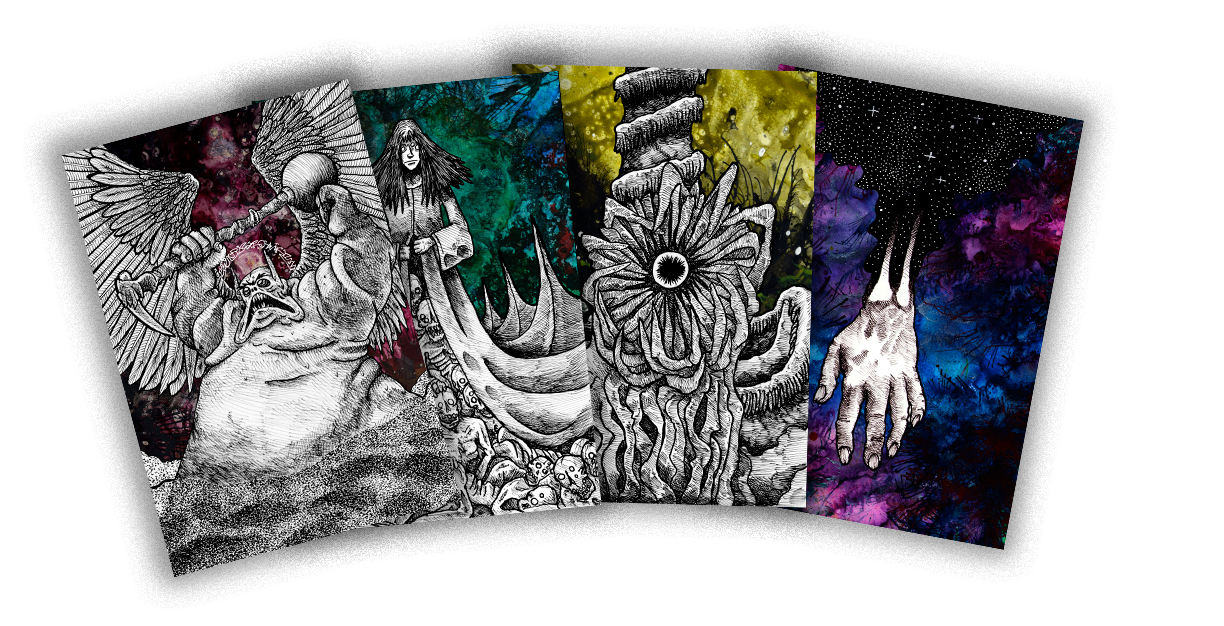
These are the final battles of the game. At the start of the 5th Realm, draw one of these cards and place it at the end of the Encounters. Each Traitor God has a unique rule set. These battles take place in a different plane of reality, so all Realm rules are disregarded. Traitor Gods are not considered Encounters. More on these in The Final Battle section.
Counters
Counters can be used to track Armor, Spell uses, Health, Reroll Counters, other quantifiable card information, or anything the players see fit.
Reroll Counters: At the start of the game, the party gains 5 Reroll Counters. These can be used to reroll any die roll or act as currency when visiting Traders. More can be acquired by defeating Targets, visiting with Traders, or when playing a Rest card.
COMBAT
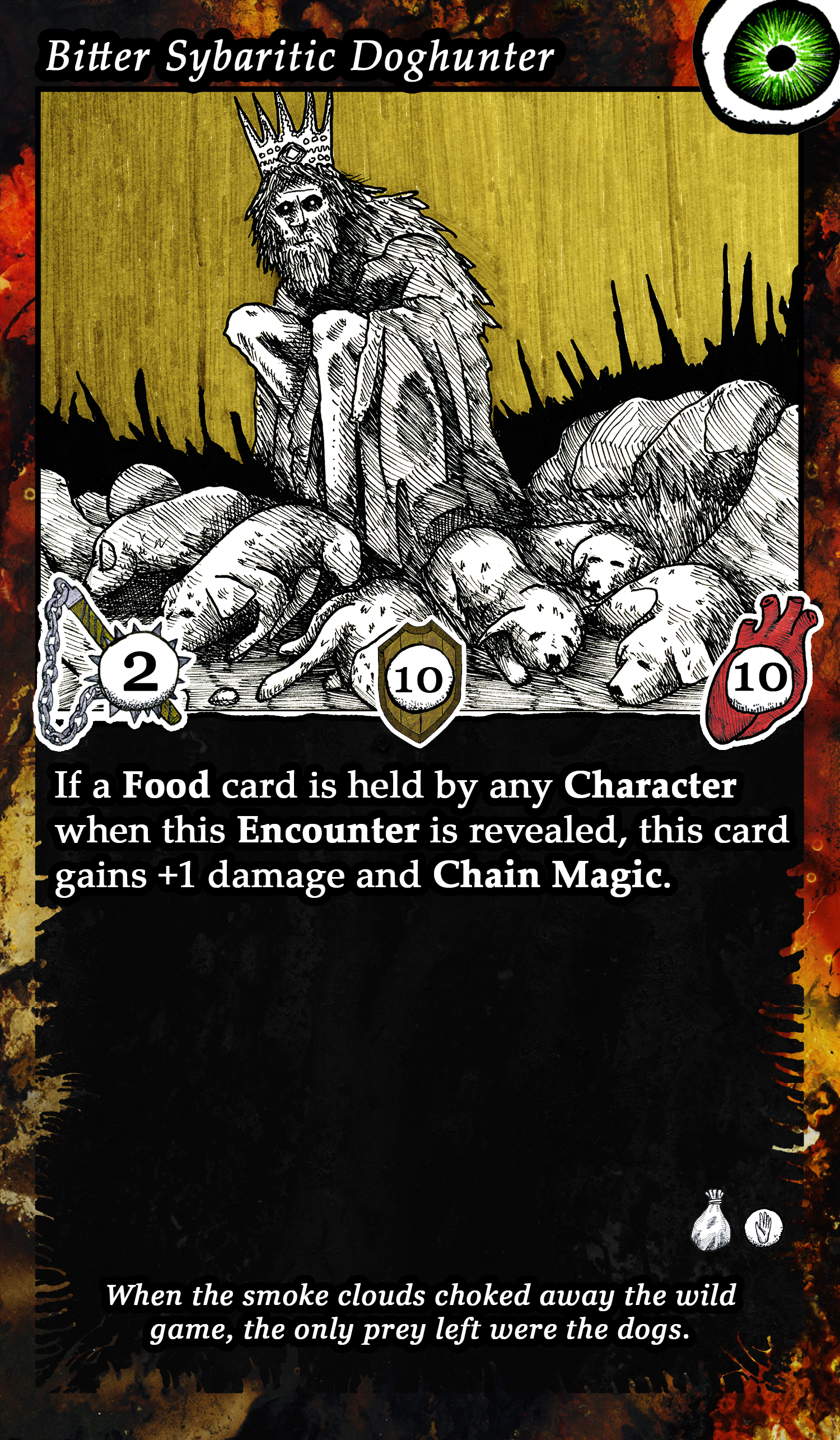
Targets: Combat Encounters are Targets. To resolve them, the party must defeat the Target or Flee from it. Targets have Types, Damage or Attack Power, Die Defense, Health, Special Text, and Drops.
Characters take turns attacking a Target with Combat, Ranged, or Dodge rolls against its Die Defense. Combat and Ranged are attack rolls.
Combat rolls: Used when attacking Unarmed or with a Melee Weapon. If the roll is equal or greater to the Die Defense, the Character deals their damage to the Target. If it is less, the Target deals damage to the Character.
Ranged rolls: A Ranged roll is a Combat roll without the risk of taking damage. If the roll is equal or greater to the Die Defense, the player deals damage to the Target. If it is less, neither Target or the Character receive damage.
Dodge rolls: A Dodge roll is only performed if the text of a card specifically requires it or when the party is Fleeing. If a Dodge roll is equal or greater than the Die Defense of the Target, the Character takes no damage. If it is less, the Target deals its damage against them.
Note on Chain Magic: Targets with Chain Magic spread their damage around the party in a chain, point by point. If a Combat or Dodge roll against a Chain Magic Target fails, the Attacking Character takes 1 damage, the Character to their left takes 1 damage, the next Character takes 1 (if required), and so on until all damage has been dealt. A Target with 3 Attack and Chain Magic will strike 3 Characters for 1 point of damage, not for 3 points each.
TAking a turn
Characters may take turns in any order so long as all Characters get a chance before repeating. When all Characters have taken a turn, they then go again in any order. Characters cannot trade items during Combat.
In a single turn, the player must:
Attack a Target: Using a Weapon, a Spell, or by attacking Unarmed. When attacking, Characters must declare which Weapon or Spell they intend to use. If none are available, they attack Unarmed. Melee Weapons replace the Character Unarmed Attack power, and do not add to it.
And may, in any order:
- Discard any of their item(s).
- Use as many Active items as desired. Turn used Active items sideways until Recharged.
- Use a Consumable. If a Character uses a Consumable, turn their Character sideways until it is their turn again. If they do not, they may do so during another Character’s turn. This effect resets at the start of their next turn and does not stack. Using a Spell in an attempt to attack a Target does not count against the one Consumable limit, so a Character is able to use both a Spell to deal damage and a different Consumable item during their turn if they wish.
Defeating a Target: When the Target reaches 0 Health, it dies. Pick a player to draw the Drops (if any) and divide them amongst the party. Place the defeated Encounter in the discard pile. Drops may only be gathered from Defeated Encounters, and not from removed or replaced Encounters.
After battle and before starting the next Encounter, the party can trade amongst themselves, play a Rest card, or proceed to the next Encounter. If instructed to fight another Combat Encounter immediately or consecutively with the previous, the party skips this step.
Fleeing: The party can Flee from a Target if desired. All Characters must roll a Dodge roll against the Target. Those who fail receive 1 damage and must try again, up to of 3 times. If the Character still fails after the 3rd roll, they take the 3rd point of damage and move on. If a Character dies while Fleeing, discard their Inventory. After Fleeing, the party cannot Rest until they defeat a Combat Encounter or arrive at any Non-Combat Encounter.
Character Death: If a Character is killed by a Target, their Inventory is added to the Drops of the Target that killed them and their Death Effect comes into play. If a Character is killed by any other means, their Inventory can be split up among the party immediately.
Players with dead Characters can re-enter the game when a Rest card is played or a new Realm is drawn. New Characters join the party with no Items, but can be given Items from surviving Characters. Players that die in the 5th Realm return before the party begins the battle with the Traitor God.
the final battle
Many other travelers have made journeys parallel to yours, and if the party arrives at the end of the 5th Realm with at least one unused Rest card, they may spend their final night with them. When doing so, use the Rest card and create a Trader with a Trader Inventory for the party to visit if they choose.
After the last Encounter of the 5th Realm is resolved, the party arrives at the Rapturous East, where the membrane that separated the planes of existence has been torn away. In a vast maelstrom of divine light, the Traitor Gods battle each other, the mortals they betrayed, and horrors from across the Cavity. Save for the conflagration before you and the blasted wastes that precede it, the whole of the world has been swallowed by smoke. It is the final day of the apocalypse.
The party can decide against entering battle with the Traitor God, to accept annihilation, and to allow the apocalypse smoke to destroy them. If this is the case, all Characters die and the game is over. This is a valid ending of the game.
If they choose to proceed, begin battle with the chosen Traitor God.
Each Traitor God is unique. They do not have Attack power, but various types of attack that vary on the Character’s failed Combat or Dodge roll. The party cannot Flee.
When the Traitor God dies, the game, and the world, is over. All things vanish into the ruinous light of death.
The cycle begins again.
Play again with a different team, new tactics, make your own cards, try challenge runs, or create new rules for a totally different style of gameplay - the game is yours.
minutiae
If the rules of a game state prevent progress, temporarily ignore the most recent rule change to allow the game to continue. Reinstate the rule when the progress is no longer prevented, if possible.
Many cards instruct you to modify rules or play off other cards. These cards can be kept for reference and discarded when no longer relevant.
Die rolls cannot exceed 20 or go below 1. If a non-Combat card interaction requires a die to fall on a particular number, this refers to the raw number on the die, not the number that would be created through additions by held cards
Random Card Selection: To randomly select a held card, shuffle your cards face-down and draw or assign numbers to your cards and roll until you land on a number that matches a card.
Random Character Selection: To randomly select a Character, assign numbers to Characters and roll the D4. When assigning random damage, any damage that points to a dead Character slot does not count unless otherwise noted. If something other than damage is being selected randomly, repeat the roll until a living Character is selected.
Discarding Cards: Discarding is removing a card from action or an Inventory and placing it into the discard pile associated with the deck from which it originated.
Reveal a Card: Some cards can be revealed before entering play. If instructed to “reveal a card anywhere”, this includes any card whose placement can be specifically described, such as “the second-to-last Encounter of this Realm,” “the next Realm/Rest/Treasure/Loot,” or “the drops of this Target", etc. Cards can still change after they have been revealed, so if a Pick From Multiple event occurs that would impact the revealed card, you must still include it as a possibility. If a Sin is ever revealed for any reason, the Character who revealed it must take it, even if taking from the drops of a Living Encounter.
Pick From Multiple: This effect allows Characters to pick from multiple options. If two or more Pick From 2 effects are occurring for the same card, they add together to create a Pick from 3, or more depending on how many are in effect. Cards not chosen are placed at the bottom of their decks, not discarded.
Challenge runs: Experienced players may increase the difficulty by starting with no Items, fewer Rest cards, adding more Encounters to each Realm, or fielding fewer Characters. Players may also use the cards in this game to invent entirely new forms of play. Do whatever you want. It’s your game, I just made it. That said, if you create a new play mode, tell me. I would love to integrate it into future versions of the game.
Questions on the rules?
I did my best to include caveats for every possible situation in this game, but no rule book can cover it all. If you encounter a conflict, decide as a party on a solution that preserves the oppressive atmosphere of the game. If you have a recurrent issue, feel free to message me here: